Even when there is no evidence that they perform significantly better..
There should be a discussion of how ivy-league students differ from non-ivy league students. This includes courses for interior design. A simple search will show how falsely enchanted and disillusioned many interior design students and architecture students are. This field of work is one of the hardest, most grueling, yet underpaid and under-appreciated types of jobs out there in the industry. In the US, its worse. Many US firms aren’t hiring due to the economy post-Covid, and this puts a strain on the job market, its demand for work, and over-supply of applicants from mainly non-ivy league schools. The disparity between both is absurd and grotesque.
Many architecture firms are Snooty, and Biased towards students who went to recognized universities, but they still DO NOT hire them. Morever, they require a masters. And the cost of it is painful. Not many people can afford to lose 5 years or a Basic degree programme and an additional 1-3 years for a Masters programme. I believe these courses are designed as a way for universities to exploit students and for profits.
It is NOT easy to attain a masters degree WHILE you are working. Going to an 8 hour a day job, then coming home to do photo-shop/Rhino? That is unrealistic. If they have a degree in architecture, a Masters is really unnecessary. You can learn all the basics of architecture that prepares you to present to clients. A masters is simply a way to be a show-pony, or show that you have a level of prestige. What I found out after looking at hundreds of portfolios online, is that there is not much difference between students who have a Degree versus students who have a Masters degree. The Ivy-leagues schools showcase work that can be done in non-ivy league schools. Creativity can be attained by reading, drawing, and imagination. Its hard to be naturally creative unless you have it in your DNA.
I am not down-playing architect students who have the income to blow on a 7-8 year course in architecture and come out getting a job instantly, but these students have the prestige that others do not, yet the rankings at some of these schools are a little skewed. I understand why firms want these Ivy students, but for those who have proven their creativity and dedication from non-ivy league schools, I think this is a biased way of looking at someone’s capabilities overall. The not-so-great universities still cover basic topics which someone can use when they leave. Rhino, 3dsmax, and all the other 30 software they want you to know instantly, has to be picked up when you graduate, and you don’t need to be an Ivy student to know these things. It is really determination that shows how well you can do in your job.
There has to be a love for something you do. And you do NOT have to be an ivy-league student to have a career in a firm, who only hires people who have a perfect CV, or who are 25 year old, and hasn’t even worked in a real firm yet, yet are struggling to get a Masters by age 27? Please..work experience is very relevant, and so is a Basic certificate course or degree course..
Another article describes how you need to network to find work. And even work for a tiny one, before stepping up the ladder..This is daunting for someone who just put in 5-8 years of torture..https://www.thearchitectsguide.com/blog/techniques-to-land-a-job-with-the-worlds-most-competitive-architecture-firms
HR Managers are an impediment to society and are incapable of hiring good designers
I have had experience with this, going through interviews with companies who had no requirements for knowing 3d work. However, they did have a requirement for having experience. I never was given a chance to work in an architecture firm, as I was never given the opportunity. Even with a recognized degree.
In this article, Elite University Grads outperform non-Elite grads only slightly…
https://hbr.org/2020/09/graduates-of-elite-universities-get-paid-more-do-they-perform-better. Slightly? Yup. Only cause they had access to better teachers, input, etc. Also the brand name doesn’t hurt. But they do Cost MORE. According to the article, about 47% more..:)
I clipped a paragraph from the article here “To a large extent, the answer would also depend on specific job demands. Does the job require a top performer from a higher-ranked university where even a 2% improvement in performance is critically important and offsets any pay differential? Or can the performance criteria be met by graduates from lesser-ranked universities? To make the most strategic decision, an HR manager should know the answer to this question before they look at an applicant’s college pedigree.”
What about HR and Hiring managers? – HR manager? HR managers are an impediment to society. Many of them cannot hire and cannot hire because they themselves have never been through a difficult architecture course. HR managers have never gone through a 5-7 year course on drafting, 3d, or a single topic related to Interior design/Architecture. Many of them are hired without experience in hiring in the industry, yet pretend to screen through candidates who are ‘good’..
In this article, the author explains that architecture firms are looking for junior architects. But they must have experience in an architecture firm. If you do not have experience in a firm, you will not be hired.
This is what one of the owners of Joseph Vance architect says “he anticipates the studio will be looking for a more junior level staff member in the coming months, someone who will need to have at least three years of experience as a minimum requirement to be considered.” What if they don’t have 3 years cause nobody in the industry gives them a chance? Even a basic recognized degree accredited by CIDA is not enough for these firms? It seems like they are looking for junior level people who managed to get into another architecture firm or design firm. I suspect they would not take a 30-40 year old worker who has just taken a new course and graduated with excellent grades because they care either ageist, biased toward people with no experience or unaware of how creative they are (Due to their hiring process).
https://archinect.com/features/article/150204365/what-architecture-firms-are-hiring-right-now.
It is laughable, that after taking a look on Harvard University’s student work , versus Cornell’s, I found that the student’s work at Cornell was more creative and interesting. This particular one title ‘generosity beyond means’, is something even an interior design student could do. I do think some interior design students are more suitable to be architecture students.
https://www.gsd.harvard.edu/project/a-generosity-beyond-means/

The above image can be done with 3dsmax, and many interior design students can pull this off likely even in the first year. Not necessarily Architecture students. This is a simple image which anyone can do in a 1st year degree course, even in interior design. https://www.gsd.harvard.edu/project/a-generosity-beyond-means/ – 4th Semester, Harvard.
https://aap.cornell.edu/student-work/constructs-exchange-topography-resistance?discipline=279


Having shown the above 2 ivy league projects, https://aap.cornell.edu/student-work/constructs-exchange-topography-resistance?discipline=279, here is one from a non-ivy league school. I think this is just as well done as the above: https://issuu.com/cpparc/docs/1801210_1400_cpp_2016_booklet_lq

https://issuu.com/cpparc/docs/1801210_1400_cpp_2016_booklet_lq
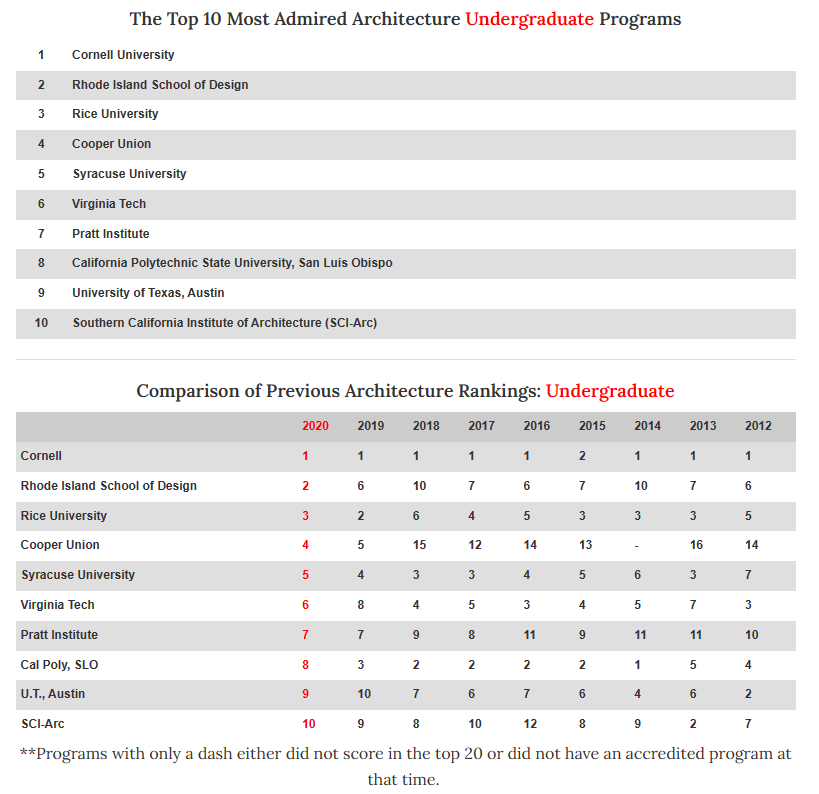
The above charts from this site https://www.architecturalrecord.com/articles/14289-americas-top-architecture-schools-2020, shows the top admired and comparison of architecture school rankings. As I suspected, it was flawed. It is just a general idea from someone’s opinion? There were 2 comments on this site which cause further doubts on why this ranking is totally skewed, as many factors need to be inputted into consideration before churning out data.
Here are the 2 comments which reaffirmed my opinion:
“I take the Design Intelligence Survey every year as a firm principal. I also meet faculty from schools across the U.S. at NCARB Licensing Advisor Summits and other academic events. However, it is still very difficult to base my survey answers on anything rational.” For now in order to have something objective in DI’s rankings they should make ARE pass rates one of the categories we look at. Although we do not want to see schools “teaching to the test” it could at least be just one of the many aspects of a schools’ quality that we can truly compare head to head. Just food for thought“….- Alexander Christoforids.
“This method of weighing architectural schools is extremely flawed. The system should be much more in-depth, looking at publications, graduation rates, facilities, faculty, programs, student work, and maybe hiring statistics. Please better represent the colleges of the united states and do more research into their programs.” – Mr East
This article says that Cornell’s acceptance rate is 11%, with a highly selective process in place. The average GPA being accepted is 4.07, and this takes almost perfect grades. Tuition fees is more than $61k for out of state students. It is known more as a STEM university, not for creative brains. To add, the school boasts more than 60 Nobel laurates, Turing awards and dozens of Olympians. https://collegegazette.com/what-is-cornell-known-for-is-cornell-a-good-school/.
According to the US News & World Report, 50% of students accepted into Cornell have an SAT score of 1400-1540 or an ACT score of 32-35. But if you want a rough idea of the SAT scores you’ll need to get in, all you need to do is comb through Cornell’s 202 admissions data.
In Cornell’s MArch of Architecture, students are given freedom to create, however, I believe that creativity can be attained also from self-learning, reading and trains of thought on architecture. It seems these schools are very concerned about sustainability; however, modernism did solve a lot of sustainability issues, but cost less than the sustainability projects we are no involved in. So, this is again questionable. https://aap.cornell.edu/academics/architecture/graduate/march/curriculum
This article was discouraging, as the author explains the various methods to win an interview with a top architecture firm. Its a grueling process, and not many make it to the top. In my opinion, the younger you are, the better. If you have a bachelors, but no masters, it would be harder. A Masters seems to be a standard requirement now in most architecture firms. However, they do not want to pay at a Masters level salary, which is absurd. https://www.thearchitectsguide.com/blog/techniques-to-land-a-job-with-the-worlds-most-competitive-architecture-firms
Another factor is the cost of going to architecture school -“We also survey students, and this year two unexpected results stood out from the 4,000-plus responses we received. First was the 5 percent drop in architecture undergraduate students wishing to go on to graduate school. The noted reasons were straightforward: accumulated debt and the marginal economic benefit that an advanced degree was thought to provide in gaining employment, as well as the drive to get out and get busy using their design skills.”
How hard is it to get a job in interior design or architecture?
The bad news is that the top firms like Gehry Partners, Herzog & de Meuron, BIG, Foster + Partners, etc. are extremely competitive. For example, most of these firms receive over 20,000 applications per year. Since they may only hire 50 people per year at most, it means you only have a 0.25% chance of getting hired! Thats according to this article: https://www.thearchitectsguide.com/blog/techniques-to-land-a-job-with-the-worlds-most-competitive-architecture-firms
An example of an Ad placed on Archinect:
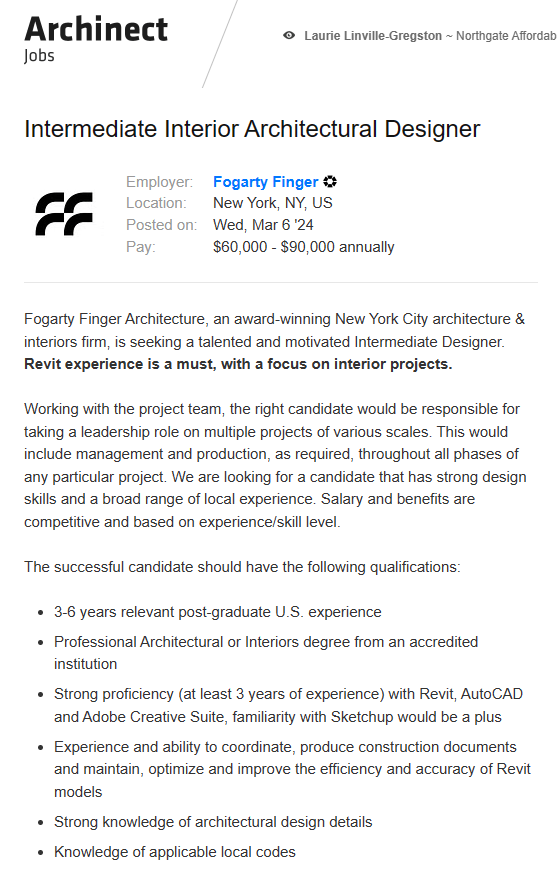
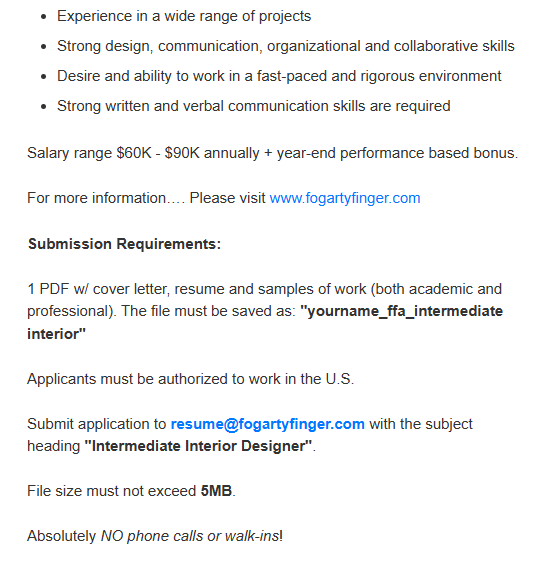
The above ad placed in March 2024, for an interior architect. Not only do you have to have 3-6 years of post-grad work experience, you need Revit, CAD, almost all of Adobe software, Sketchup?? (Most interior design firms do not use revit+sketchup+Cad, unless you are a larger architectural firm), and you can’t be good at both and be an expert at both. So unless you are doing REVIT, CAD & Sketchup and spending all your time trying to be good at both (even on weekends), then it is impossible to get a job like this.
Oh and if nobody gave you a chance at a prior architecture firm, you won’t be able to move up the ladder with these types of jobs. A salary of $60K per annum is pretty reasonable, but not enough given the inflation currently in the US. This seems almost too much of a tall order for any architectural designer to attain. – Oh and they don’t want walk-ins or phone calls..something other architects have recommended, if having trouble finding a job..
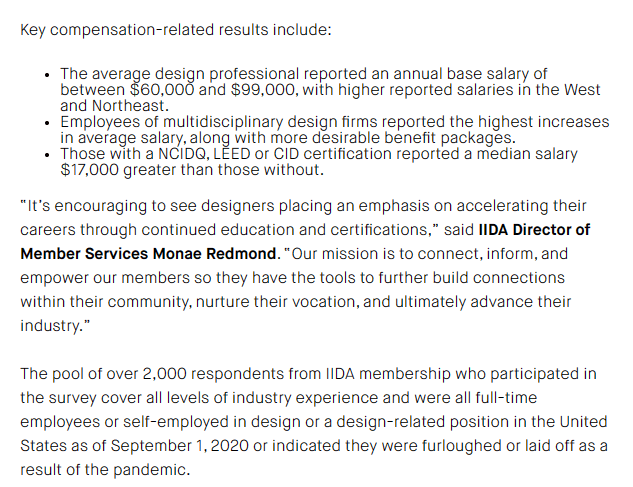
The above report was published by https://iida.org/press-release/84097. Just to break that down, it is between $5000 and $8250 per month. If they had LEED, NCIDQ or CID qualifications, they would gain another $1416 per month. This is quite substantial; however this could be based on various middle management roles, or people with 8-10 years or experience. Majority of firms would not even pay that much with that amount of experience. Firms in the Northeast and Westcoast project higher salaries compared to other states. A copy of the IIDA salary report can be purchased here fore $75. https://iidaprod.my.site.com/AssociationLightningMemberPortal/s/store#/store/browse/detail/a152K000003cEIPQA2.
According to this article, the average for a junior interior designer is $4166 per month. A senior designer is $6166 per month. This the lower end of what is offered in the industry. So I am not sure if this is completely accurate. With the numbers being higher on west and East coast firms, those figures could be a median, but still somewhat inaccurate given the competition in the larger cities hiring. https://www.houzz.com/pro-learn/blog/startup-guide-interior-design-how-much-do-interior-designers-make
Do interior designers and architects know how to get business?
This article mentioned at the bottom of the article, several sources from which you could potentially get recruited such as linkedin, Monster, Naukri, Shine, LinkedIn, Stepstone, Glassdoor. None of these I found, helped me. In fact, they only demoralized me further, as there were no replies, or rejections letters. https://www.andacademy.com/resources/blog/interior-design/complete-guide-to-interior-designer-salaries/
– Freelance options: Freelancing options are worse, as the article proposes tips on providing freelance options on linkedin and squarespace. These are quite impossible, as you would need to run alot of ads on instagram, facebook or other social media pages to get projects. How else would you get traffic to your website without placing ads?
– Networking: Many designers are unaware of how to start their own businesses and end up getting duped by fake marketing companies. Networking is a more useful method, though in the US, many people are possessive over their jobs, and do not want to give an open spot to a struggling, fresher designer who has not worked for a firm for a minimum of 1-3 years in an interior architecture firm..If you are in an ivy-league school, your chances would be higher obviously..
–Networking the right way: If you know of someone who wants to design their home, they would probably prefer someone who has some experience, or a nice portfolio. (I found this was not a necessity). But knowing or having personal connections would help you get your firm started, so you can spin-off from there. Advertising in higher net worth magazines or local neighbourhood newsletters, dropping off mailers into mailboxes, could get you good clients, and 1 or 2 clients would be enough for a 1 person designer to start raking in cash. Marketing books can help you learn strategies of targeting the right people in the economy. There are many avenues, and you shouldn’t be demoralized by these snooty architectural firms who want cookie-cutter academics. If you have a great personality, you would likely be making more money than the ivy league grads.
–Local interior design companies: This requires persistency, unless you have a great portoflio from a recognized university. Calling does not really work, unless you show up and hand them a impressive portfolio when you show up to their office.
Letters or recommendations and shadowing: Shadowing a senior designer is recommended, so you can get a letter or recommendation. Some recommendation letters do not even work, if you dont have the qualifications to meet their requirements. Sometimes a recognized degree would not even work. You might have to get a Masters, to get recognized.
This article provides some information on how to reach out to architecture firms who might be hiring: https://www.thearchitectsguide.com/blog/techniques-to-land-a-job-with-the-worlds-most-competitive-architecture-firms
I highly recommend this site to anyone looking for a job in interior design or architecture. Specifically, architecture. https://www.thearchitectsguide.com/blog/want-a-great-architecture-job-dont-send-a-resume
One of the important statements made by the author is: “Great jobs, world class jobs, jobs people kill for… those jobs don’t get filled by people emailing in resumes. Ever.”
–Seth Godin
Another thing the author adds is: “Let me repeat that: most of the new hires at top architecture offices come from word of mouth.“
The reason I agree with this is because I have applied to Gensler in my state and they told me not to call them, as they get hundreds of applications per month. They may be hiring internally or through word of mouth. Remember that these firms are like a tight cohort. They think alike, have the same objectives, they have built a culture where they understand one another. Breaking into this, is extremely hard, and may be impossible.
If you can’t call or email them your resume (because it does not work), then the last resort would be to show up at their office, and tell them you would like to work for free in exchange for you putting their brand on your resume. This in turn helps you monumentally. By working for free, you will gain experience on your resume, and you can use this to apply to a firm. If this is the path you have chosen, this is something you might have to do to gain in the long run. Do remember that your future employer will be impressed by your determination to not accept pay.
I wanted to emphasize, I have equal respect for ivy and non-ivy league students. What I do not agree with, is that an ivy league student is given better opportunities, compared to a non-ivy league student. I find this hypocritical. Software, techniques and knowledge are all attainable without going through these ‘accredited’ schools. Education should be affordable, if the person is talented. If they are talented and creative, and read, they should be allowed INTO these firms.
The brainwashing many architecture Ivy schools teach, emphasize too much on avant-garde and ultra-modern or abstract work like Zaha Hadid and Gehry. Now, they are putting sustainability into courses, and this defeats the purpose of an architect. Although sustainability is leading the charge in getting LEED accredited, courses on sustainability, etc, this takes alot of approval and involves alot of processes. I completely agree with using sustainability to improve the environment. But not using gas or fire, is unrealistic and we cannot completely remove natural gas from society. Lead batteries use much more natural resources than Oil, Gas or LNG ever will. There are firms who have just a sustainability lead to keep up with these new rules. And I would like to ask how much money are these sustainable companies making each year?
Making cities attractive by focusing on form and function, instead of sustainability as the bulk of the objective, architecture has moved away from its purpose. Buildings do not look nice, they look like weird spaceships, feel cold and without purpose, without being built into the surroundings, which doesn’t fit them at all. Chipperfield and Meier still respect the principles of architecture and apply them. Architecture firms now, are getting worse, I believed due to the type of academics they are being pushed. This is another topic which can unravel much more..
 Sketchez.art