The Basilica of Sant’ Apollinare Nuovo is a basilica church in Ravenna, Italy. It was erected by the Ostrogothic king Theodoric the Great as his palace chapel during the first quarter of the 6th century (as attested to in the Liber Pontificalis). This Arian church was originally dedicated in 504 AD to “Christ the Redeemer”.[1]

On some columns, images of arms and hands can be seen, which are parts of figures once representing praying Goths and Theodoric’s court, deleted in Byzantine times.
It is important to identify and acknowledge the reason why the mosaic on the basilica was removed during byzantine times. This is due to Arianism and Nicean being at conflicts with one another, over the which creed was approved and recognized by the apostolic council.
Arianism is a nontrinitarian Christological doctrine, which asserts the belief that Jesus Christ is the Son of God, who was begotten by God the Father at a point in time. Many Goths when they converted to Christianity adopted Arian beliefs. The Vandal regime in North Africa actively imposed Arianism.
It must also be noted that prior to this temple being erected, that Arianism was a type of orthodoxy, and it was attempted to be resolved by the ecumenical councils. The Ecumenical First Council of Nicaea of 325, convened by Emperor Constantine to ensure Church unity, disagreed and declared Arianism to be a heresy.
Constantine the great, however, who was baptized by the arian bishop, rebelled against the teachings of Athanasius, who was exiled into Trier (modern Germany). After Athanasius returned to Alexandria in 346 AD, Arianism had spread, and other trinitarian church leaders crusaded against the theology, and Arius was again anathemised and and pronounce a hereti at the Ecumenical first council of Constantinople of 381 (attended by 150 bishops). Many Goths had converted to Arian beliefs. This was continued by the Vandals in Africa, who spread Arianism there.
In 325, the council of Nicaea were constantly debating over the Nicene creed, and the Arian view. The arians were encouraged in 269 AD to continue the arian creed, until the time of Emperor Valens, who exiled bishops supporting the Nicean creed.
Sadly, it was not until the co-reigns of Gratian and Theodosius that Arianism was effectively wiped out among the ruling class and elite of the Eastern Empire. Valens died in the Battle of Adrianople in 378 and was succeeded by Theodosius I, who adhered to the Nicene Creed.
Medieval Germanic tribes were tolerant towards other creeds, and by the 8th century had begun to adopt Nicean orthodoxy. Sadly, the remaining tribes – the Vandals and the Ostrogoths – did not convert as a people nor did they maintain territorial cohesion. Having been militarily defeated by the armies of Emperor Justinian I, the remnants were dispersed to the fringes of the empire and became lost to history.
In the west, organized Arianism survived in North Africa, in Hispania, and parts of Italy until it was finally suppressed in the 6th and 7th centuries. Visigothic Spain converted to Catholicism at the Third Council of Toledo in 589.[2] Grimoald, King of the Lombards (662–671), and his young son and successor Garibald (671), were the last Arian kings in Europe.
The Ostrogoths traced their origins to the Greutungi a branch of the Goths who had migrated southward from the Baltic Sea and established a kingdom north of the Black Sea, during the 3rd and 4th centuries. They built an empire stretching from the Black Sea to the Baltic. The Ostrogoths were probably literate in the 3rd century, and their trade with the Romans was highly developed. [3]
Theodoric the Great (454 – 30 August 526)
Theodoric is an important figure in medieval German literature as the character, Dietrich von Bern, known also in Icelandic literature as Þiðrekr. In German legends, Dietrich becomes an exile from his native kingdom of Lombardy, fighting with the help of Etzel against his usurping uncle, Ermenrich. Only the Old High German Hildebrandslied still contains Odoacer as Dietrich’s antagonist.
It is important to note that, the church was erected prior to the conversion of the gothic kingdoms to Christianity, which occurred during 7th century AD. The main rival doctrine of Nicene Christianity at the time of Nicaea, Arianism, became eclipsed during the 7th century AD with the conversion of the Gothic kingdoms to Nicene Christianity. The main points of dissent centered on Christology. Nicene Christianity regards Christ as divine and co-eternal with God the Father, while Arian Christianity treated Christ as the first created being and inferior to God the Father. Other non-Nicene currents have been considered heresies since the early medieval period.[4]
About the Basilica, and its influences
It was reconsecrated in 561 AD, under the rule of the Byzantine emperor Justinian I, under the new name “Sanctus Martinus in Coelo Aureo” (“Saint Martin in Golden Heaven”). Suppressing the Arian church, the church was dedicated to Saint Martin of Tours, a foe of Arianism. According to legend, Pope Gregory the Great ordered that the mosaics in the church be blackened, as their golden glory distracted worshipers from their prayers. The basilica was renamed again in 856 AD when relics of Saint Apollinaris were transferred from the Basilica of Sant’Apollinare in Classe because of the threat posed by frequent raids of pirates from the Adriatic Sea.
Its apse and atrium underwent modernization at various times, beginning in the 6th century with the destruction of mosaics whose themes were too overtly Arian or which expressed the king’s glory, but the mosaics of the lateral walls, twenty-four columns with simplified Corinthian capitals, and an Ambo are preserved.
On some columns, images of arms and hands can be seen, which are parts of figures once representing praying Goths and Theodoric’s court, deleted in Byzantine times. The question, is why would this be removed by the Byzantines? Would it be because the Jewish bible and its influence to take over the Germanic people have always started to fool people with a fairy-tale myth? According to Alister McGrath, the Jewish Christians affirmed every aspect of the then contemporary Second Temple Judaism with the addition of the belief that Jesus was the Messiah.[3] Unless males were circumcised, they could not be God’s People. Gnosticism greatly influenced the eastern and western roman empire, including Italy and outside Rome, mainly due to Jewish diaspora.
Renovations (and alterations) were done to the mosaics in the mid-19th century by Felice Kibel. The present apse is a reconstruction after being damaged during World War I.[5]
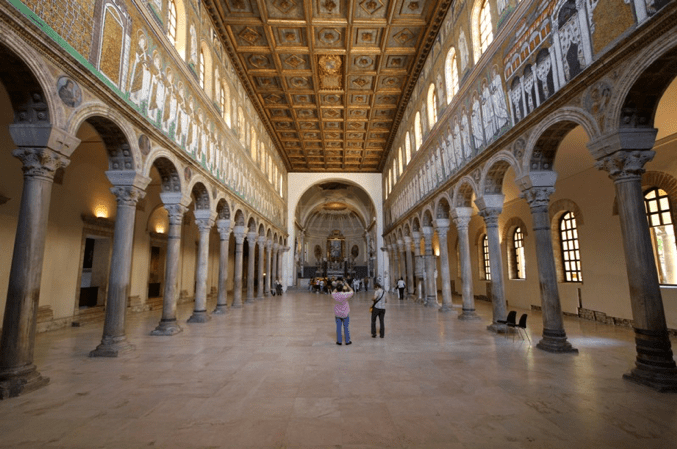
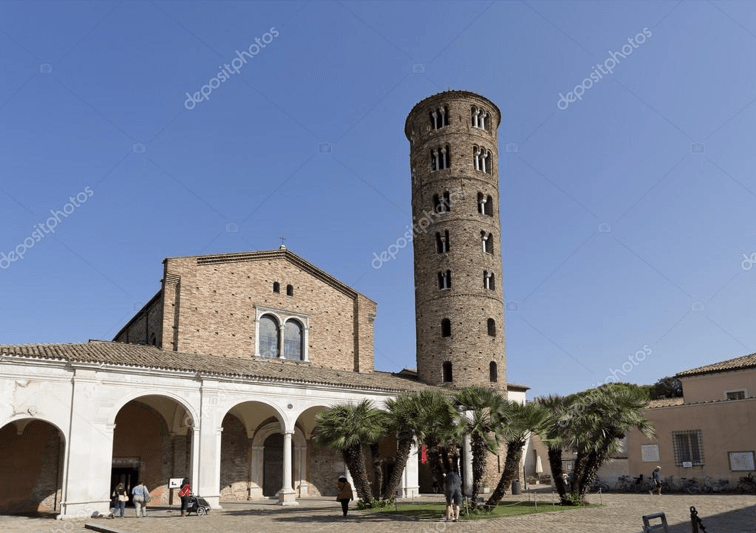
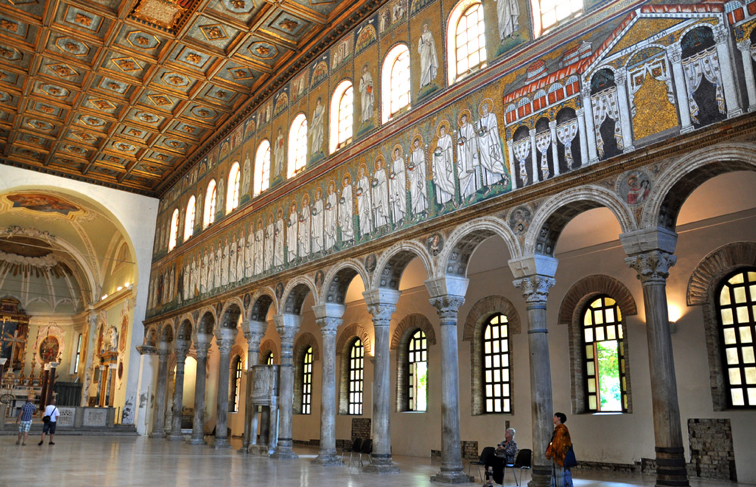
Right wall of the Nave
This is the right wall of the nave. The three bands of mosaics correspond to those on the left wall.
Upper Band
The uppermost band (partly shown here) presents Christ’s passion.
Middle Band
The middle band features various prophets, evangelists, and other saints.
Lower Band
Below these is a procession of 26 male martyrs from the city of Ravenna toward the throne of Christ (at the left in this photo).
The church was built as an Arian cathedral by Theodoric the Great in 504. But Ravenna was subsequently conquered by the Orthodox Byzantines, and in 561 the church was rededicated tor Orthodox worship. At about that time the original mosaics were revised. Scholars assume that the revisions were made to remove anything suggesting Arianism and to emphasize Orthodox beliefs.[9]


The procession mosaic is clearly influenced by Revelation chapter 4, where God sits enthroned among “four living creatures” and receives the “golden crowns” of 24 ancients in white who sing “Thou art worthy, O Lord our God, to receive glory, and honor, and power.” The “glory” in their song corresponds to the words Ego sum rex gloriae (“I am the King of Glory”) in the book that was in Christ’s left hand before the mosaic was restored in the nineteenth century.
The four “creatures” have been rendered here not as the odd beasts in Revelation 4 but as four angels carrying the wands that in images of the Emperor signify his authority, as do Christ’s purple robe and of course the throne itself.[12]
Originally an Arian palace chapel, the church was rededicated in 561 as an Orthodox basilica under the patronage of St. Martin of Tours, who was not a martyr but a celebrated opponent of Arianism.3 Thus the Orthodox revisions to the mosaics have placed him at the head of the procession and given him a purple cloak to distinguish him from the martyrs in white behind. The cloak could also be a reminder of the story of Martin’s giving half his cloak to a poor beggar who was actually Christ himself. [13]

The way of the cross
Soldiers lead Jesus to Calvary. Behind the soldier in blue is Caiaphas, who is also pictured in the same garb in the scenes of Jesus’ trial before the Sanhedrin and Judas’ attempt to return the money. Behind Caiaphas is an associate of his in the same clothing, hair, and beard as the accuser in the Trial Before the Sanhedrin and (possibly) the Pharisee in The Parable of the Pharisee and the Publican.
On the right in the red tunic, Simon of Cyrene carries the cross, as the synoptic gospels specify. (In John’s gospel, Jesus carries the cross himself.) Like two of the men to the left, Simon is pictured with only one leg, an oversight perhaps incident to the revising of the mosaics in 561.
This is one of the 13 mosaics of the Passion and Resurrection of Christ along the upper band of the right wall of the nave.
Right Wall of the Nave, upper band:

The last supper
As in the earliest images of the Last Supper, the 13 men recline around a central table. The bread and fish on the table may refer to the miracle of the loaves and fishes portrayed on the opposite wall. The “Bread of Life” discourse (John 6:22-59) explicitly relates that miracle to the Eucharist, which Jesus is believed to have instituted at the Last Supper. A similar composition in the catacombs makes the same connection by placing a multitude of bread baskets on the side tables.
This is one of the 13 mosaics of the Passion and Resurrection of Christ along the upper band of the right wall of the nave. [17]
Jesus in the garden of Gethsamene
In the gospels, after the Last Supper Jesus takes his apostles (minus Judas) to pray in the Garden of Gethsemane (Mt 26:36-46, Mk 14:32-42, Lk 22:39-46, Jn 18:1). Here we see him in orant position – that is, with his arms extended in prayer. The gospel passages show Jesus struggling with sorrow and dread, but in the mosaic he prays calmly in a pastoral setting. This may be because the artist or sponsor wanted to avoid possible Arian implications of a fearful Jesus.
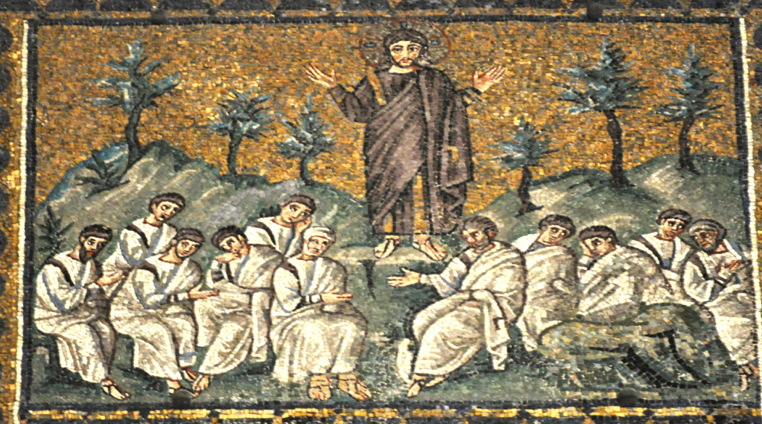
The image is also kinder to the apostles than the gospel passages, which say they fell asleep while Jesus was praying in his agony. Here we see them engaged in some sort of lively discussion.
This is one of the 13 mosaics of the Passion and Resurrection of Christ along the right wall of the nave. It can be identified as Gethsemane because there are only 11 apostles and because in the series on the wall it is between the Last Supper and the Kiss of Judas. The two figures at Jesus’ feet are St. Peter and St. Andrew. The latter has the same head of wild, rounded hair that he wears in the scenes of the Calling of Andrew and Peter and the Miracle of the Loaves and Fishes. Following tradition, the mosaic gives Peter a short, square beard. Throughout the mosaics on both walls, he always has gray hair, presumably a sign of his “senior” status.[19]
Left Wall of the Nave
The uppermost band presents 13 events in the life of Christ alternating with decorative panels. The narrative panels portray a youthful, beardless Jesus, always in a purple toga, and the apostles are invariably shown in white togas, each with two shoulder-to-hem purple stripes. This is the garb of Roman senators (example). The stripes, but not the togas, are also seen on the bishop and deacons in a contemporary mosaic in nearby San Vitale (image).
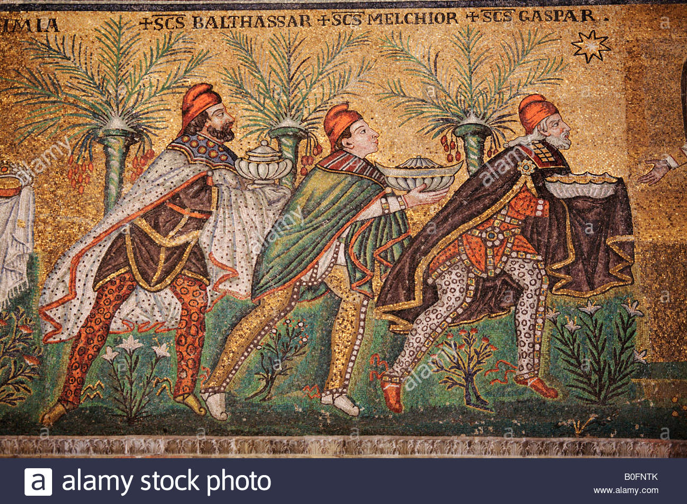
In the mosaics of the Passion on the opposite wall, the garb is the same but Jesus has no beard. In the middle band are 16 prophets, evangelists, and other saints. Below that, 22 virgin saints process from the city of Classe toward the throne of the Virgin and Child, led by the three Magi.
The throne is flanked by four angels. The church was built as an Arian cathedral by Theodoric the Great in 504. But Ravenna was subsequently conquered by the Orthodox Byzantines, and in 561 the church was rededicated tor Orthodox worship. At about that time the original mosaics were revised. Scholars assume that the revisers wished to remove anything suggesting Arianism and to buttress Orthodox beliefs. [20]


This is the left wall of the nave. The three bands of mosaics here are paired with those on the right wall.
This is the left wall of the nave. The three bands of mosaics here are paired with those on the right wall.
Upper Band:
The uppermost band presents 13 events in the life of Christ alternating with decorative panels. The narrative panels portray a youthful, beardless Jesus, always in a purple toga, and the apostles are invariably shown in white togas, each with two shoulder-to-hem purple stripes. This is the garb of Roman senators (example). The stripes, but not the togas, are also seen on the bishop and deacons in a contemporary mosaic in nearby San Vitale (image).
Middle Band:
In the middle band are 16 prophets, evangelists, and other saints.
Third Band:
Below that, 22 virgin saints process from the city of Classe toward the throne of the Virgin and Child, led by the three Magi. The throne is flanked by four angels.[24]
Mosaics on the upper band of the left wall, depicting the life of Christ

The paralytic in Matthew
This is one of the 13 mosaics of the life of Christ along the upper band of the left wall of the nave. A young and beardless Jesus tells the paralytic to “rise, pick up your bed, and go home” (Matthew 9:1-8). As so often in this series, the fingers of Jesus’ right hand are arranged in the “Old Believers” configuration.

The Gerasene Demoniac
This is one of the 13 mosaics of the life of Christ along the upper band of the left wall of the nave. It follows Matthew 8:28-34, Mark 5:1-20, and Luke 8:26-39.
In details, it is closest to Mark and furthest from Matthew. In Mark and Luke there is one Gerasene demoniac and he lives “among the tombs” near a hillside with a steep cliff that drops to the sea. The mosaic follows this geography economically, framing the demoniac against a cave in a hill with one side steeper than the other.
In all three accounts the demons possessing the man ask Jesus to send them into a nearby herd of swine. The swine then run off the cliff into the sea. Aiming as always for an eloquent simplicity, the artist uses just three swine for Luke’s “many” and Mark’s “about two thousand.”
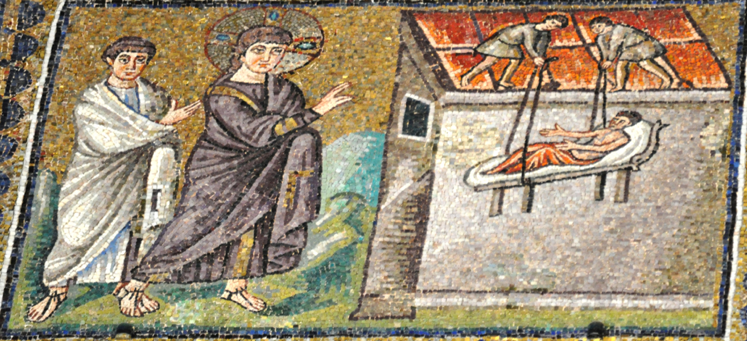
The Paralytic let through the roof
This is one of the 13 mosaics of the life of Christ along the upper band of the left wall of the nave. In Mark 2:1-5 and Luke 5:17-26 the friends of a paralytic try to take him to the house where Jesus is staying, but it is so crowded that they cannot get in. [28]
So, they uncover part of the roof and let him down into the house, where Jesus heals him and forgives his sins. For the sake of compositional simplicity, Jesus and (perhaps) John are placed outside on the left as the man is let down into the house on the right. The curvy headboard suggests that what the man is lying on is a bed (lectus, the word used in the Vulgate Luke) rather than a pallet or camp cot (Mark’s grabatus). Also suggestive of Luke is the use of just two friends: Luke gives no number; Mark says there were four. But again, simplicity of composition may be what determined the artist’s choice. [29]
[1] Wikipedia.“Basilica of Sant’ Apollinare Nuovo.” Wikipedia.com https://en.wikipedia.org/wiki/Basilica_of_Sant%27Apollinare_Nuovo#cite_note-2 (accessed Nov 24, 2019)
[2] Thompson, E.A., “The Conversion of the Visigoths to Catholicism”, Brepolsonline.net: accessed 24 Nov 2019, doi: https://doi.org/10.1484/J.NMS.3.5
[3] Wikipedia.“Basilica of Sant’ Apollinare Nuovo.” Wikipedia.com https://en.wikipedia.org/wiki/Basilica_of_Sant%27Apollinare_Nuovo#cite_note-2 (accessed Nov 24, 2019)
[4] “The Procession of Martyrs at Sant’Apollinare Nuovo,” christianiconography.info, accessed: 24 Nov 2019. https://www.christianiconography.info/Edited%20in%202013/Italy/sApolNuovoRightNave.html
[5] Wikipedia.“Basilica of Sant’ Apollinare Nuovo.” Wikipedia.com https://en.wikipedia.org/wiki/Basilica_of_Sant%27Apollinare_Nuovo#cite_note-2 (accessed Nov 24, 2019)
[6] Ravenna Masaici, “La basilica di Sant’Apollinare Nuovo è un’ex chiesa Ariana,” fidelityhouse.eu, https://viaggi.fidelityhouse.eu/basilica-di-sant-apollinare-nuovo-a-ravenna-60314.html. Accessed 24 Nov 2019.
[7] Ribeiroantonio, Ravenna Bazilika svatého Apolináře, Feb 26, 2015, Basilica of Sant’ Apollinaire, Italy, https://cz.depositphotos.com/66022457/stock-photo-ravenna-basilica-of-saint-apollinare.html
[9] “Right side of the Nuovo at Sant’Apollinare Nuovo,” christianiconography.info, accessed: 24 Nov 2019. https://www.christianiconography.info/Edited%20in%202013/Italy/sApolNuovoRightNave.html
[10] Wikipedia.“Basilica of Sant’ Apollinare Nuovo.” Wikipedia.com https://en.wikipedia.org/wiki/Basilica_of_Sant%27Apollinare_Nuovo#cite_note-2 (accessed Nov 24, 2019)
[11] “Right side of the Nuovo at Sant’Apollinare Nuovo,” christianiconography.info, accessed: 24 Nov 2019. https://www.christianiconography.info/Edited%20in%202013/Italy/sApolNuovoRightNave.html
[12] “Right side of the Nuovo at Sant’Apollinare Nuovo,” christianiconography.info, accessed: 24 Nov 2019. https://www.christianiconography.info/Edited%20in%202013/Italy/sApolNuovoRightNave.html
[13] “The Procession of Martyrs at Sant’Apollinare Nuovo,” christianiconography.info, accessed: 24 Nov 2019. https://www.christianiconography.info/Edited%20in%202013/Italy/sApolNuovoRightNave.html
[14] “The Procession of Martyrs at Sant’Apollinare Nuovo,” christianiconography.info, accessed: 24 Nov 2019. https://www.christianiconography.info/Edited%20in%202013/Italy/sApolNuovoRightNave.html
[15] “The Procession of Martyrs at Sant’Apollinare Nuovo,” christianiconography.info, accessed: 24 Nov 2019.https://www.christianiconography.info/Edited%20in%202013/Italy/sApolNuovoRightNave.viaCrucis.html
[16] “Right side at Sant’Apollinare Nuovo,” christianiconography.info, accessed: 24 Nov 2019. https://www.christianiconography.info/Edited%20in%202013/Italy/sApolNuovoRightNave.html
[17] “Right side at Sant’Apollinare Nuovo,” christianiconography.info, accessed: 24 Nov 2019. https://www.christianiconography.info/Edited%20in%202013/Italy/sApolNuovoRightNave.html
[18] “Left side of the Sant’Apollinare Nuovo,” christianiconography.info, accessed: 24 Nov 2019. https://www.christianiconography.info/Edited%20in%202013/Italy/sApolNuovoLeftNave.html
[19] “Left side of the Sant’Apollinare Nuovo,” christianiconography.info, accessed: 24 Nov 2019. https://www.christianiconography.info/Edited%20in%202013/Italy/sApolNuovoLeftNave.html
[20] “Left side of the Sant’Apollinare Nuovo,” christianiconography.info, accessed: 24 Nov 2019. https://www.christianiconography.info/Edited%20in%202013/Italy/sApolNuovoLeftNave.html
[21] World History Archive / Alamy Stock Photo. 19 October 1904. World History Archive / Alamy Stock Photo (accessed 24 Nov 2019).
[22] Wikipedia.“Basilica of Sant’ Apollinare Nuovo.” Wikipedia.com https://en.wikipedia.org/wiki/Basilica_of_Sant%27Apollinare_Nuovo#cite_note-2 (accessed Nov 24, 2019)
[23] Wikipedia.“Basilica of Sant’ Apollinare Nuovo.” Wikipedia.com https://en.wikipedia.org/wiki/Basilica_of_Sant%27Apollinare_Nuovo#cite_note-2 (accessed Nov 24, 2019)
[24] “Left side of the Sant’Apollinare Nuovo,” christianiconography.info, accessed: 24 Nov 2019. https://www.christianiconography.info/Edited%20in%202013/Italy/sApolNuovoLeftNave.html
[25] “Right side at Sant’Apollinare Nuovo,” christianiconography.info, accessed: 24 Nov 2019. https://www.christianiconography.info/Edited%20in%202013/Italy/sApolNuovoRightNave.html
[26] “Right side at Sant’Apollinare Nuovo christianiconography.info, accessed: 24 Nov 2019. https://www.christianiconography.info/Edited%20in%202013/Italy/sApolNuovoRightNave.html
[27] “Right side at Sant’Apollinare Nuovo,” christianiconography.info, accessed: 24 Nov 2019. https://www.christianiconography.info/Edited%20in%202013/Italy/sApolNuovoRightNave.html
[28] “Right side at Sant’Apollinare Nuovo,” christianiconography.info, accessed: 24 Nov 2019. https://www.christianiconography.info/Edited%20in%202013/Italy/sApolNuovoRightNave.html
[29] “Right side at Sant’Apollinare Nuovo,” christianiconography.info, accessed: 24 Nov 2019. https://www.christianiconography.info/Edited%20in%202013/Italy/sApolNuovoRightNave.html
 Sketchez.art